
The Galaxy S21 vs Galaxy A17 decision is less obvious than their ages suggest. The S21 is an older flagship with stronger premium features. The A17 5G is newer, cheaper new, and supported for longer.
For most U.S. buyers wanting a new phone, the A17 5G is the safer long-term purchase. Buyers prioritizing cameras, performance, wireless charging, and premium features may prefer a good S21. Condition and battery health matter greatly when buying the older model.
Galaxy S21 vs Galaxy A17 at a Glance
| Feature | Samsung Galaxy S21 5G | Samsung Galaxy A17 5G |
|---|---|---|
| Original position | Flagship | Budget / entry-level |
| Display | 6.2-inch Dynamic AMOLED 2X | 6.7-inch Super AMOLED |
| Refresh rate | Up to 120Hz | 90Hz |
| Storage | 128GB or 256GB | 128GB U.S. model |
| Expandable storage | No | Yes, microSD support |
| Main rear cameras | 12MP + 64MP + 12MP | 50MP + 5MP + 2MP |
| Battery | 4,000mAh | 5,000mAh |
| Wired charging | Up to 25W | Up to 25W |
| Wireless charging | Yes, up to 15W | No |
| Water resistance | IP68 | IP54 |
| Samsung DeX | Yes | No |
| Software outlook | Near the end of its support life | Six years of OS and security updates |
| Best for | Performance, cameras, premium features | Battery, longevity, storage, new-phone value |
Quick verdict: Choose the Galaxy A17 5G if you want a new Samsung with longer software support and better battery capacity. Choose the S21 if performance, camera flexibility, a 120Hz screen, wireless charging, and stronger water resistance matter more. A used S21 only makes sense when its condition and price are attractive.
Samsung’s U.S. A17 page confirms a 6.7-inch Super AMOLED screen and six years of software support. Samsung also gives the phone IP54 protection and optical stabilization for its main camera.
The S21 launched as a much more expensive flagship. Its specification sheet includes a 120Hz AMOLED display, IP68 protection, wireless charging, Wireless PowerShare, and Samsung DeX.
Display: Bigger A17 or Smoother S21?
The A17 gives you considerably more screen space. Its 6.7-inch panel works well for videos, reading, navigation, and social media. Buyers who prefer large phones will likely appreciate that extra area.
The S21 uses a smaller 6.2-inch Dynamic AMOLED 2X panel. Its 120Hz adaptive refresh rate makes scrolling and animations look smoother. Samsung originally paired that screen with HDR10+ support and a 2400 x 1080 resolution.
Size may matter more than specifications for some buyers. The S21 feels more compact and easier to manage one-handed. The A17 makes more sense when a large display is the priority.
Performance: The Older Flagship Still Has an Advantage
Age does not automatically make the A17 faster. The S21 was designed as a flagship and uses considerably higher-end hardware. That difference can still matter with demanding applications and games.
The A17 focuses on everyday performance instead. Messaging, web browsing, video streaming, navigation, and normal app use are its natural workload. Buyers expecting flagship gaming performance should keep their expectations realistic.
The S21 is therefore the stronger option for heavier workloads. Yet performance should not be considered separately from battery condition. A five-year-old phone may have lost noticeable battery capacity even when its processor remains fast.
Cameras: S21 Offers More Flexibility
The S21 has a more versatile rear camera system. Samsung equipped it with 12MP wide, 12MP ultrawide, and 64MP telephoto-oriented cameras. It also supports high-resolution 8K video recording and optical image stabilization.
The A17 uses a 50MP primary camera with OIS. It also includes a 5MP ultrawide and 2MP macro camera. Samsung lists a 13MP front camera for the A17.
Megapixel counts alone shouldn’t decide this comparison. The S21 provides more useful camera flexibility, especially for zoom and ultrawide shooting. The A17 should satisfy buyers mainly taking casual daytime photos.
Battery Life: A17 Has the Clear Capacity Advantage
Battery capacity strongly favors the newer phone. The A17 includes a 5,000mAh battery with 25W wired charging. Samsung does not include wireless charging or Wireless PowerShare on this model.
The S21 has a smaller 4,000mAh battery. It supports 25W wired charging and 15W wireless charging. Wireless PowerShare can also charge compatible accessories from the phone.
Real-world battery condition creates another issue for S21 shoppers. Most available units are now used or refurbished. Battery wear can reduce endurance compared with the phone’s original performance.
Software Support Strongly Favors the A17
Software longevity is one of the A17’s strongest advantages. Samsung promises six generations of operating-system upgrades and six years of security updates. That support starts from the device’s initial global launch.
The S21 originally shipped with Android 11 in 2021. Its supported lifetime is therefore much longer. Buyers planning to keep their next phone for several years should weigh that heavily.
Long support affects more than new visual features. Security patches also matter for banking, communications, authentication, and personal data. TechPufy’s lock screen security guide explains several related device-security considerations.
Storage: A17 Is Better for microSD Users
Both phones can handle normal storage needs, but their approaches differ. The S21 shipped with 128GB or 256GB of internal storage. Samsung did not include a microSD slot.
Samsung’s U.S. A17 configuration includes 128GB of internal storage. The phone supports external memory expansion with microSD cards up to 2TB.
That makes the newer model appealing for offline media collections. Photos, videos, music, and downloaded files can consume storage quickly. Expandable storage gives owners more flexibility without replacing the phone.
Durability and Premium Features
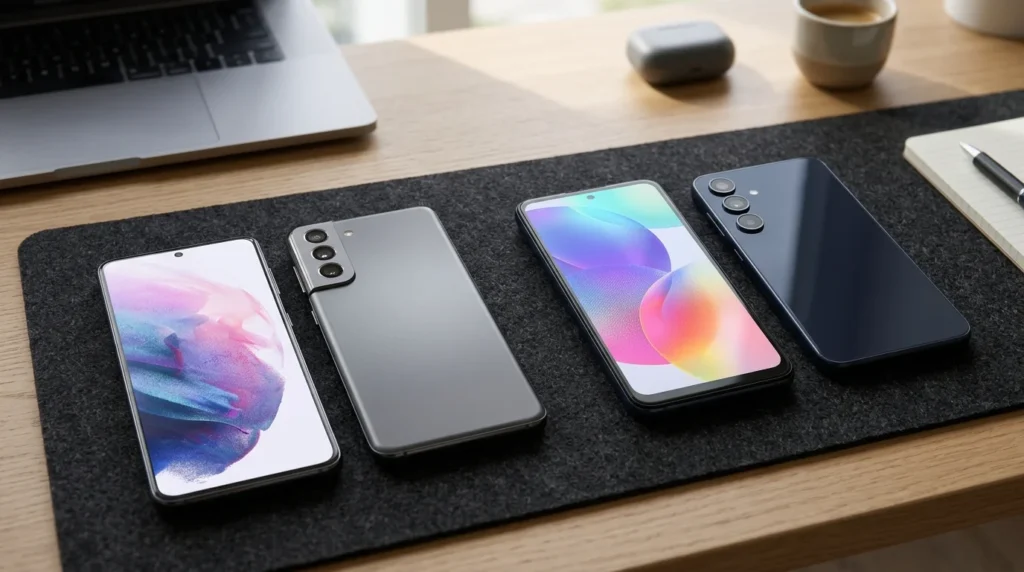
The S21 retains several features normally associated with higher-tier phones. Its IP68 rating provides stronger water and dust protection than IP54. It also includes Samsung DeX and wireless charging.
The A17 offers IP54 protection against dust and splashes. Samsung also uses Gorilla Glass protection on the front. It should still receive normal day-to-day protection from a suitable case.
Neither rating makes careless water exposure a good idea. The difference becomes more relevant for accidental splashes, rain, or occasional outdoor use. Used S21 units may also have reduced water resistance after previous repairs.
Galaxy S21 vs Galaxy A17: Pros and Cons
Galaxy S21 Pros
* Faster flagship-class performance * Smoother 120Hz Dynamic AMOLED display * More versatile camera hardware * IP68 dust and water resistance * Wireless charging and Wireless PowerShare * Samsung DeX support * Smaller, lighter form factor
Galaxy S21 Cons
* Much older device. * Most U.S. units are now used or refurbished. * Smaller 4,000mAh battery. * No microSD expansion. * Far less remaining software support. * Battery condition varies between individual units.
Galaxy A17 5G Pros
* Newer model with a warranty when purchased new * Six years of software and security support * Larger 5,000mAh battery * Large 6.7-inch AMOLED display * microSD storage expansion * 50MP main camera with OIS * Available directly through Samsung in the U.S.
Galaxy A17 5G Cons
* 90Hz rather than 120Hz refresh rate * Less powerful performance * Weaker secondary cameras * No wireless charging * No Samsung DeX * IP54 rather than IP68 protection
U.S. Price and Buying Considerations
Samsung currently sells the unlocked 128GB A17 5G directly in the United States. Its listed retail price was \$269.99 during this research. Carrier pricing and promotions can differ.
The S21 is no longer a current-generation retail phone. Buyers will mainly encounter refurbished, renewed, or secondhand stock. That makes direct price comparisons difficult because condition affects value.
Before buying an older unit, check battery health, screen burn-in, camera operation, charging, and network compatibility. Verify that the phone is unlocked if you plan to switch carriers. A strong return policy is especially valuable for refurbished hardware.
Which Phone Should You Buy?
The A17 5G is the better choice for most mainstream U.S. buyers in 2026. It provides a large battery, current software, expandable storage, and years of updates. Buying new also reduces much of the uncertainty around aging hardware.
The S21 remains appealing to buyers who value flagship features. Its display, camera versatility, performance, IP68 rating, DeX support, and wireless charging remain useful. It can be excellent value when purchased in strong condition.
Price should determine the final decision. An expensive refurbished S21 becomes difficult to recommend against a new A17. A clean S21 at a low price can still offer more premium hardware for your money.
For more Android phone guidance, TechPufy’s notification history guide covers useful Samsung settings. You can also browse the Gadgets and Apps section for more consumer-device coverage. Both resources can help after you set up a new phone.
Frequently Asked Questions
Is the Galaxy S21 better than the Galaxy A17?
The S21 is better for raw performance, display smoothness, cameras, wireless charging, and water resistance. The A17 is better for battery capacity and long-term software support. The right choice depends on whether you value flagship hardware or newer support.
Which has better battery life?
The A17 has the larger battery on paper. Its capacity is 5,000mAh compared with 4,000mAh in the S21. An older S21 battery may also have significant wear.
Does the Galaxy A17 have wireless charging?
No, Samsung states that the A17 does not support wireless charging. It supports wired charging at up to 25W. The S21 supports both wired and wireless charging.
Which phone has the better camera?
The S21 has the more capable overall camera system. It provides stronger ultrawide and zoom options than the A17. The A17 still offers a stabilized 50MP main camera for everyday photography.
Is the S21 still worth buying in 2026?
It can be worth buying at a low price in excellent condition. Its flagship hardware still offers several advantages over entry-level phones. Limited remaining software support makes it less attractive for long-term ownership.
Which is better for long-term use?
The A17 is the safer long-term choice. Samsung promises six years of operating-system and security support. A new battery and warranty also reduce ownership uncertainty.
Final Verdict
For most people buying today, the A17 5G offers the better ownership proposition. Its battery, software support, expandable storage, and new-device availability matter more over several years. It is particularly sensible for everyday users who do not need flagship gaming performance.
The S21 remains the more capable phone in several hardware categories. Choose it when premium display quality, cameras, DeX, or wireless charging are priorities. Make sure the savings justify buying an older device with a shorter support future.
Neither phone wins every category. The A17 wins on longevity and practical value, while the S21 wins on premium hardware. Match those strengths to how you plan to use your phone.