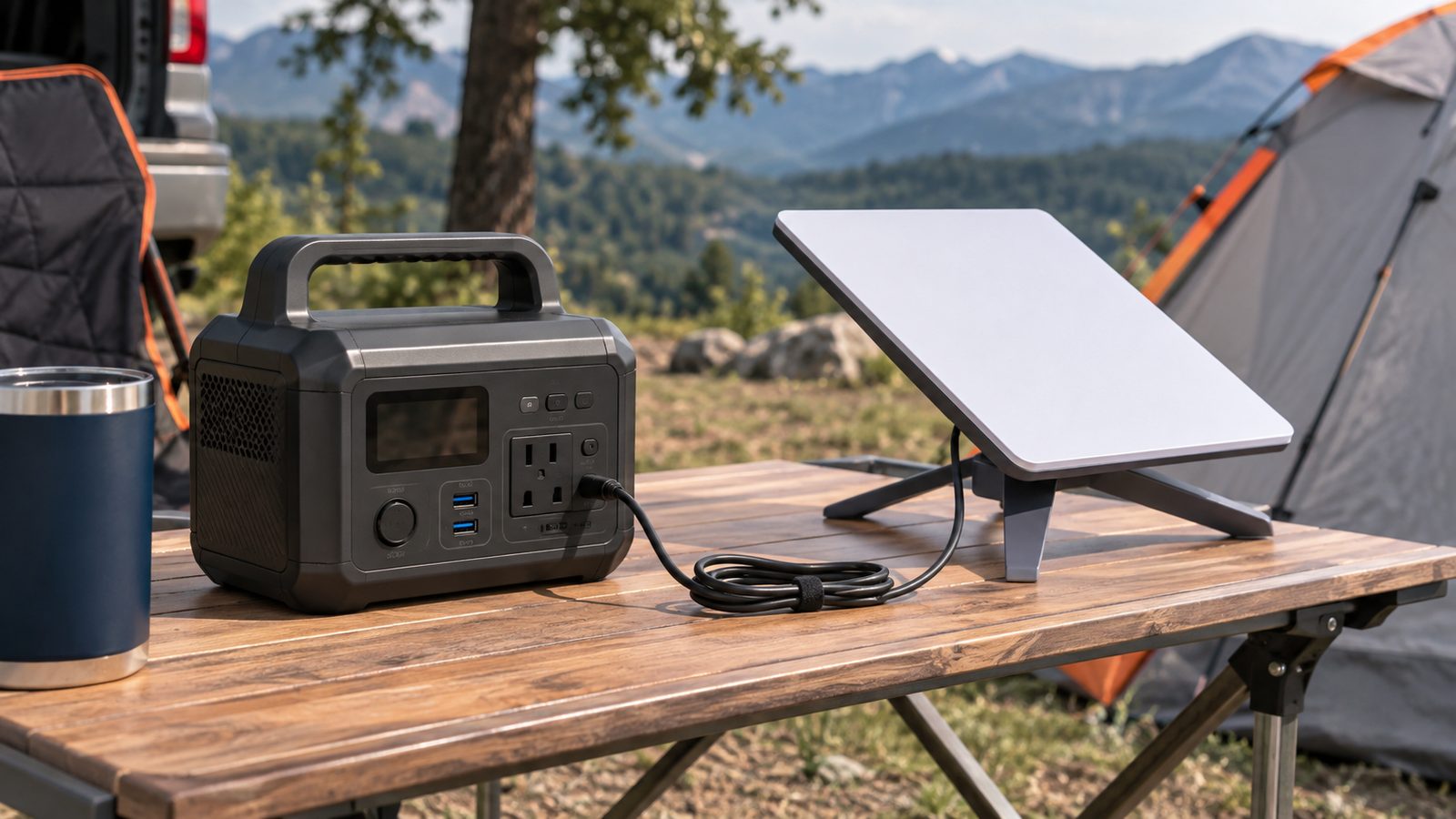
A Starlink Mini battery pack can keep your satellite internet running during camping trips, outages, road travel, and remote work. The right battery must provide enough output, not merely enough storage capacity. For USB-C power, Starlink specifies a 100W Power Delivery source capable of 20V at 5A. Quick answer: Choose a battery with enough watt-hours for your required runtime and the correct output for the dish. A 99Wh pack suits shorter portable sessions and airline travel. Larger batteries offer longer runtime but add weight and may face stricter airline rules.
| What to check | Recommended target | Why it matters |
|---|---|---|
| USB-C output | 100W PD, 20V/5A | Meets Starlink’s USB-C power requirement |
| Battery capacity | About 99Wh for portability | Balances size, runtime, and travel convenience |
| Longer-use capacity | 150Wh or more | Better for workdays and extended outages |
| Pass-through charging | Preferred | Lets the battery charge while supplying power |
| Weather resistance | IP-rated where needed | Useful for outdoor and campsite setups |
| Connection | Compatible USB-C or direct DC | Avoids incompatible cables and adapters |
| Airline use | 100Wh or less is simplest | Larger batteries face additional FAA restrictions |
How Much Power Does the Starlink Mini Need?
Starlink states that its compact dish typically consumes about 20W to 40W during normal operation. Idle consumption can fall to approximately 15W, although actual demand varies. Temperature, network activity, and operating conditions can change the power draw. That average consumption can create confusion when choosing a portable battery. A 40W average draw does not mean a 40W USB-C charger is suitable. Starlink currently specifies a 100W USB-PD source at 20V/5A when using its USB-C power option. The terminal can also accept 12V to 48V DC power with a 60W input rating. This creates useful alternatives for RV, vehicle, solar, and permanent off-grid installations. Direct DC power can also avoid some conversion losses associated with AC inverters.
Choosing the Right Starlink Mini Battery Pack
Start with output compatibility before comparing battery capacity. A large battery becomes useless if its required port cannot supply the correct voltage and power profile. Check the output of one individual port rather than a manufacturer’s combined multi-port rating. Next, compare battery capacity using watt-hours instead of milliamp-hours alone. Watt-hours provide a more useful measurement of stored energy across different battery voltages. A pack advertised as 27,000mAh may hold roughly 99Wh, depending on its internal cell voltage. You should also consider the physical setup around the battery. A generic power bank is flexible, while a clip-on pack creates a cleaner portable system. A larger power station makes more sense when several devices need electricity simultaneously.
Key features worth prioritizing:
* A USB-C PD port supporting the required power profile. * Clearly stated watt-hour capacity. * Pass-through charging for uninterrupted use. * Battery temperature and overload protection. * A dependable battery-level indicator. * Outdoor protection for camping or field work. * Low weight when hiking or flying. * Direct mounting when compactness matters.
How Long Will a Battery Run the Dish?
Runtime depends on usable battery energy and the terminal’s changing power consumption. Dividing watt-hours by watts provides a useful starting estimate. Real runtime is shorter because batteries and power conversions are never perfectly efficient. Consider a 99Wh power bank as an example. At a continuous 20W draw, the theoretical result approaches five hours before accounting for losses. At 40W, the theoretical result drops below two and a half hours. Real products therefore advertise noticeably different runtimes from similar battery capacities. Some 99Wh dedicated packs claim around four to five hours under lighter operating conditions. Heavy network use, cold weather, and higher power demand can shorten those figures.
| Battery class | Approximate use case | Practical expectation |
|---|---|---|
| Around 99Wh | Flights, hiking, short sessions | Several hours, depending on load |
| Around 150–160Wh | Longer remote sessions | Roughly half a working day or more |
| 250–500Wh station | Workdays and outages | Extended use with extra device capacity |
| 1,000Wh station | Camps, cabins, emergency backup | Long sessions and multiple electronics |
Treat manufacturer runtime claims as estimates rather than guarantees. Check whether a claimed result assumes 20W, 25W, or another fixed load. Comparing products without checking that assumption can produce misleading conclusions.
Clip-On Battery vs USB-C Power Bank vs Power Station
The best design depends on how you expect to use the connection. Backpackers usually care about weight, while an RV owner may prioritize runtime. Emergency users may need enough capacity for phones and laptops as well.
| Option | Portability | Runtime potential | Best for | Main drawback |
|---|---|---|---|---|
| Clip-on battery | Excellent | Short to medium | Camping and mobile setups | Often designed for one device |
| USB-C power bank | Excellent | Short to medium | Travel and flexible charging | Requires careful output checking |
| Portable power station | Moderate | Medium to long | Outages and remote work | Heavier and bulkier |
| DC battery system | Low to moderate | Long | RVs, vans, cabins | Requires more installation work |
A clip-on model is attractive when you want the dish and battery to move together. Some current products place roughly 99Wh directly behind the terminal. Several also include tripod mounting and pass-through charging. A general-purpose power bank can provide more flexibility. You can use it with compatible laptops, phones, and other electronics when satellite service is not needed. Make sure its qualifying USB-C port can supply the required output by itself. Portable power stations provide the easiest path to longer runtime. They offer considerably more stored energy and often provide USB-C, DC, and AC connections. Their extra capacity comes with increased cost, size, and weight.
Pros and cons of a compact battery
Pros:
* Easy to carry in a backpack or vehicle. * Faster setup than many wired battery systems. * Useful for outages and field work. * Some models mount directly to the dish. * 99Wh models can simplify airline travel.
Cons
* Limited runtime compared with power stations. * High-output models can cost considerably more. * Heat can affect battery performance. * Some attached designs obstruct ports. * Manufacturer runtime claims use different test conditions.
Examples of Current Battery Options
Several product styles are available in the U.S. market. The examples below illustrate how specifications can differ rather than naming one universal winner. Prices and availability can change, so check current manufacturer information before purchasing. The Ennzia E100 uses a 99.36Wh battery designed specifically for the portable terminal. Its manufacturer lists roughly 2.5 to five hours of runtime depending on power demand. The design also uses direct DC output and an integrated mounting arrangement. PeakDo’s LinkPower family offers another attached-battery approach. The newer LinkPower Ultra was announced with 99.9Wh of capacity and claimed runtime reaching 5.5 hours. Its capacity also stays below the common 100Wh airline threshold. Larger products such as the 158Wh Ravion Gen 2 trade portability for increased runtime. Its seller lists an estimated six to nine hours of operation. That capacity also changes how you should plan airline travel.
What Battery Size Is Best for Camping?
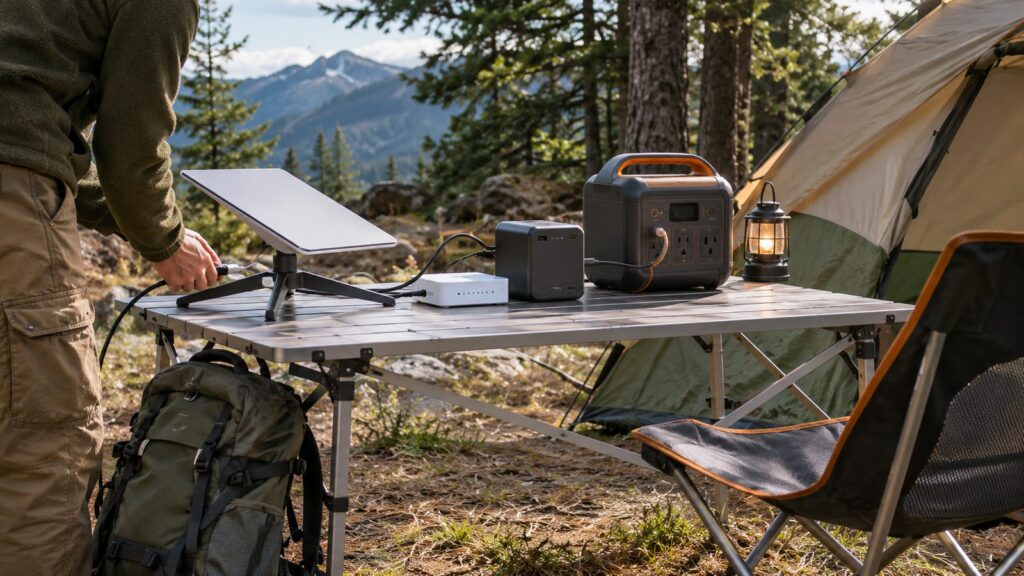
For short camping sessions, a battery around 99Wh offers a useful balance. It keeps the setup easier to carry while providing several hours of potential operation. This size also works well for people flying before reaching their destination. A larger battery makes more sense when internet access supports a full remote-work schedule. A 250Wh or larger power station gives you more energy reserve. It can also support a laptop, phone, lighting, and other campsite electronics. For multi-day off-grid use, charging becomes as important as battery size. Solar panels, vehicle charging, or a generator can extend your available operating time. Build the system around daily energy consumption rather than buying the largest battery available.
Using a Battery During U.S. Air Travel
The Federal Aviation Administration bases lithium battery limits on watt-hours. Rechargeable batteries rated from zero through 100Wh are generally permitted under its passenger battery rules. Spare lithium batteries and power banks must travel in carry-on baggage rather than checked baggage. Batteries between 101Wh and 160Wh require airline approval under FAA guidance. Passengers can generally carry no more than two qualifying spare batteries in that range. Individual airlines can apply stricter policies, so verify the carrier’s rules before departure. That distinction explains why many portable satellite batteries sit close to 99Wh. They maximize usable capacity while remaining under the standard 100Wh threshold. Never rely on the advertised milliamp-hour figure when airline compliance depends on watt-hours.
The Cable Matters Too
The official USB-C solution requires more than a suitable battery. Starlink offers a dedicated USB-C to barrel-jack cable for its compact dish. The cable replaces the longer DC power cable supplied with the standard kit. Starlink specifies a 100W, 20V/5A power source for that USB-C cable. Its barrel-jack connection provides weather protection when properly installed. The USB-C end itself should remain protected from outdoor exposure. Long or undersized DC wiring can also produce voltage problems. Starlink recommends reducing cable length or using thicker wiring if 12V setups become unreliable. Higher supported DC voltage can help in installations where voltage drop becomes significant.
How to Pick the Best Option for Your Setup
Choose by starting with how many hours of internet you genuinely need. Then select enough watt-hours for that workload, including a margin for conversion losses. Finally, confirm that the battery’s output and cable match the terminal’s electrical requirements. For air travel or lightweight camping, a quality pack near 99Wh is usually the most practical choice. For remote working or longer outages, a larger power station offers more useful reserve. For RVs and cabins, a properly designed direct-DC system can provide longer-term efficiency. Don’t buy based on capacity alone. Output specification, cable compatibility, charging speed, weather protection, and weight can matter equally. A smaller compatible battery is more useful than a larger pack that cannot provide the required output.
Frequently Asked Questions
Can a 65W power bank run the Starlink Mini?
For USB-C operation, you should follow Starlink’s current 100W, 20V/5A specification. A lower-rated charger may not provide the required operating profile. Choosing the specified output also reduces compatibility problems during higher demand.
How many hours does a Starlink Mini battery pack last?
Runtime depends on watt-hour capacity and the dish’s real power consumption. A compact battery around 99Wh commonly targets several hours of use. Higher demand, temperature, and conversion losses can shorten the result.
Can I use a regular USB-C laptop power bank?
You can use a compatible power bank when one port meets the required USB-PD specification. Check the individual port rating instead of the combined charger wattage. You will also need the appropriate cable for powering the dish.
Is a 100Wh battery allowed on a U.S. flight?
FAA guidance permits lithium-ion batteries rated from zero through 100Wh within its normal passenger limits. Power banks and spare batteries must remain in carry-on baggage. Airlines may impose additional restrictions beyond the federal baseline.
Is a power station better than a small battery?
A power station is better when runtime matters more than portability. Its larger capacity can also power laptops and other equipment. A small battery is easier to carry for hiking, travel, and short deployments.
Final Recommendation
For most travelers, campers, and mobile users, start with a reputable battery near 99Wh. Confirm 100W USB-PD support when using Starlink’s USB-C power method. Favor clear watt-hour ratings, pass-through charging, thermal protection, and dependable construction. Choose a larger power station when you need a full workday or emergency backup. RV and cabin users should also consider direct DC systems for longer installations. Match the battery to your daily energy needs instead of focusing on the largest advertised capacity. Before ordering, verify the manufacturer’s current specifications and Starlink’s latest power requirements. Travelers should also check their airline’s lithium battery policy before packing. That final check can prevent both compatibility problems and airport surprises. —