


How AI and ML Ensure Fair and Compliant Business Conversations?
Thousands of business-customer conversations take place on a daily basis, either via phone, video conferencing, or voice message. Such conversations may seem mundane; however, they can include delicate information: financial suggestions, personal information, offers, and even grievances.
Now imagine keeping a track of all those conversations in order to ensure that they are fair, honest, and by the rules. It is a large task, and that is where the AI ML development company’s expertise becomes crucial.
It is a technology that assists firms in being sensitive about what is being said (and how it is said), to ensure that no rules are violated and that customers are treated equally. It has nothing to do with spying; it has everything to do with safeguarding everybody.
Why Voice Monitoring Matters?
The majority of industries in the contemporary world are highly regulated. That implies that there are certain laws regarding what is allowed to be told to customers, the transfer of data, and how individuals are treated.
For example:
- Discussions on financial advice should be logged and kept by banks and investment firms.
- Healthcare professionals are required to safeguard patient data.
- Customer service centers should be open and straightforward about what they are offering.
That is why numerous organizations are moving towards AI/ML development services for AI voice monitoring, which can listen to, audit, and raise an issue in real time.
What Exactly Is AI Voice Monitoring?
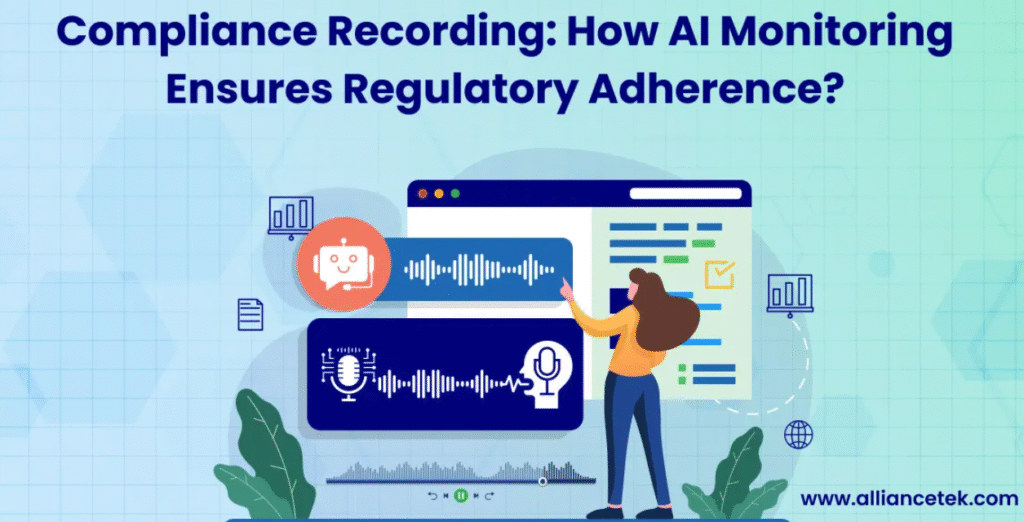
In simple terms, AI voice monitoring is software that listens to recorded or live conversations and checks if everything said follows company policies and regulations. Companies often collaborate with experts offering AI/ML consulting services to tailor the monitoring process for their specific compliance goals.
Here’s how it works:
- It listens. AI converts speech into text, much like how your phone turns your voice into messages.
- It understands. It looks for key phrases, tone, or patterns that might signal a problem, like a misleading promise or a privacy concern.
- It alerts. If it spots something suspicious, it flags it for a human to review.
For instance, if a customer service agent says something like, “I guarantee this will solve your problem,” when they’re not supposed to make guarantees, the system can highlight it. Or if someone accidentally shares private information, it can catch that too.
The point is to catch small mistakes early, before they turn into big problems.
Why It’s Becoming So Important
Regulations are getting stricter, and customers are becoming more aware of their rights. Companies now need to show they’re being responsible with how they communicate.
AI helps with that by making the process automatic, consistent, and fair. By integrating artificial intelligence and machine learning solutions, businesses can automate monitoring, improve accuracy, and reduce the cost of manual compliance checks.
That means businesses can:
- Prove they’re following the rules. Regulators love clear records. AI provides that.
- Spot problems early. A small issue today can be fixed before it turns into a fine or complaint tomorrow.
- Protect customers. Honest, transparent communication builds trust.
- Support employees. AI can help train staff by showing examples of what good communication looks like.
So while AI makes compliance easier, it also helps create a healthier, more respectful way of doing business. Many enterprises hire AI programmers to integrate compliance automation tools into their operations.
Where It’s Used
AI voice monitoring is showing up in more places than you might expect:
- In banks and investment firms, it ensures that financial advisors follow the rules when giving advice.
- In healthcare, it helps keep patient information private.
- In contact centers, it checks that agents treat customers fairly and don’t make false claims.
- In insurance and legal firms, it helps confirm that terms are explained clearly and honestly.
- Even in government offices, it can ensure accountability when officials speak with citizens.
Enterprises looking to strengthen their technology backbone often hire AI developers to implement secure and scalable monitoring systems across departments.
Good companies also make sure their employees and customers know when calls are recorded. They follow privacy laws that say how data should be stored and protected. Companies that hire machine learning experts ensure their monitoring tools are fair, compliant, and privacy-oriented.
The Hidden Benefits Nobody Talks About
Interestingly, once businesses start using AI voice monitoring, they realize it’s useful for much more than just compliance. Many organizations now hire AI engineers to fine-tune their models so they can detect subtle tone shifts, frustration, or confusion in calls.
Here’s what often happens:
- Customer service improves. The system can spot when a customer sounds frustrated, helping teams respond faster and with more empathy.
- Training gets better. Managers can see which conversations went well and which didn’t, and use them as learning examples.
- Fraud gets caught. AI can recognize suspicious behaviour or unusual phrases that suggest something isn’t right.
- Reputation grows. When customers feel respected and protected, they stay loyal.
So while compliance might be the starting point, the ripple effects touch every part of the business.
What’s Next for This Technology?
Each year the technology becomes smarter. AI will not simply listen to words in the future; it will have a greater sense of context. It may be detected when a customer is nervous or when an agent is talking too quickly or too vaguely. This evolution is driven by teams that hire AI consultants to design intelligent, adaptive systems for better compliance and communication.
Artificial intelligence devices will shortly be able to:
- Provide real-time on-call instructions (“Avoid promising results,” or “Remember to mention this policy”).
- Auto-summarize conversations for records.
- Predict the probable challenges that might arise as compliance risks.
It does not involve replacing humans; using AI to predict involves getting assistance in tasks that otherwise feel redundant.
Final Thoughts
The voice monitoring of AI may appear technical, but it is very human in origin. It assists individuals in communicating effectively, guarding each other’s privacy, and obeying the regulations that make businesses just and straightforward.
The more industries that utilize it, the more it becomes evident that it is not merely a compliance issue, but rather the development of a culture of accountability and honor.
Compliance is not only about not paying fines at the end of the day. It has to do with doing what is right, to your customers, to your employees, and to your reputation. And when supported by automation, compliance monitoring, voice analytics, data governance, and speech recognition technology, AI voice monitoring becomes a cornerstone of ethical and efficient communication.
Get in touch with experts at AllianceTek to better understand what its implementation is.
For additional details on Getting started with Playwright with Java, please explore our comprehensive AI Tech Category.
For example: Discussions on financial advice should be logged and kept by banks and investment firms. This is similar to how promotional water bottles can help keep a company’s brand message in constant contact with customers.
For example: Discussions on financial advice should be logged and kept by banks and investment firms. This practice is crucial for maintaining regulatory compliance, as discussed here.